Swift Garage Door Repair covers Kirkland daily. Springs, openers, cables and doors off their tracks, same day where we can.
Tell us what the door is doing. No charge to come out, and nothing to pay if you decide against it.
A snapped cable or seized roller is the fault we're called out for most often in Bellevue, and it's the one homeowners least expect. Nothing wears visibly, nothing sounds wrong, and then one morning the door won't lift and the car is shut in. Around Kirkland and Crossroads we see it concentrated in large custom homes with three-car garages and heavy insulated doors, where persistent moisture warps wood and pits hardware.
Two cables run from the bottom brackets, up the sides, and wind onto drums at each end of the torsion shaft. They're what actually carries the door's weight to the spring. If one lets go, the door drops on that side, jams in the track and comes off the rails. Which is why a cable failure and an off-track door usually arrive as one call.
Anywhere in Bellevue or Kirkland, Redmond, Renton, Issaquah the visit and the written estimate cost nothing. If you decide not to go ahead after seeing the estimate, you owe nothing.
A cable warns you before it goes. Run your eye along its length: broken strands stand out from the lay of the wire like whiskers, usually near the bottom. Compare the two sides. One slack while the other is tight means a cable has already slipped its drum. And if the door has started closing crooked, it's past the warning stage.
If any of that matches, a technician can diagnose it on site in about ten minutes. We don't guess at it down the phone, and we don't charge to look.
A galvanized cable lasts as long as its coating does. The end that sits at the bottom bracket lives closest to a floor that gets wet, so that's where the zinc goes first, and that's where the strands start to part. Rollers are a shorter story: the unsealed plastic ones builders fit have no bearings worth the name and are finished inside seven years.
Cables go back in pairs. They have carried identical loads for identical years, and the drums have to be set equally or the door will sit permanently a little out of square. While it's apart, sealed-bearing nylon rollers are the upgrade actually worth paying for. Quieter, far less drag on the track, and several times the life of the plastic ones.
A roller that has seized takes the track with it, so a roller replacement that's left too long turns into a track repair. If we're already there for a cable, changing the rollers at the same time costs the parts and almost no extra labor.
People put this off, and it is worth being straight about where that goes. None of the following is unusual. It's the ordinary sequence, and we see it in Bellevue every week.
The visit and the written estimate are free, so finding out where you stand costs you nothing at all. That is the whole reason to call early rather than late.
Persistent moisture warps wood and pits hardware. Split by component, the effect is not evenly distributed:
| Part | What the local climate does to it |
|---|---|
| Torsion spring | Surface corrosion removes section, stress concentrates there, and the spring fails short of its cycle rating. |
| Lift cables | Rust starts at the bottom bracket end, closest to the floor, and works up the lay of the wire. |
| Rollers | Grit and moisture together destroy unsealed bearings; sealed nylon rollers are largely immune. |
| Bottom seal | Hardens, cracks, and stops sealing - after which the weather is inside the garage rather than outside it. |
| Opener | Suffers indirectly. Every one of the above makes the door heavier to move, and the nylon drive gear is what pays for it. |
None of it is exotic and none of it needs a special product. It needs looking at twice a year, which is the part most people in Bellevue skip.
Every job runs the same way, and it's worth knowing what that's before you pick up the phone.
You'll get a real arrival window rather than a day, and a call before the technician sets off. If we're going to be late you hear it from us first.
Nothing is charged for the visit or for the estimate. The technician looks at the door, tells you what has failed and why, and writes the price down. If you decide against it at that point you owe nothing and there's no pressure applied.
If you go ahead, what was written down is what happens. The only way that changes is if something else is found once the door is apart, and then it's quoted separately and agreed before it's done. Not added on at the end.
Before we leave, the door is cycled several times, balanced by hand, and the opener's safety reversal is tested with an obstruction. The work is warranted in writing on parts and labor.
The bottom bracket is the one fitting on a garage door that carries the entire spring load, and on most doors there's a warning label on it saying so. Undo that bolt with the counterbalance still wound and the whole system releases at once, through whatever is in the way. This isn't a cautious-and-you-will-be-fine job.
There's no safe way to keep using it, and there's no prize for trying. Load that should be on the counterbalance goes somewhere else instead. Hinges, brackets, the opener's gear. And each of those is a bigger job than the part that actually failed.
If the car has to come out, do it with the door fully down and the opener released. A partly-raised door with no working spring will finish the journey by itself.
The difference between a job finished today and a job finished on Thursday is almost always whether the right part was on the van when it arrived. So the van is loaded for what Bellevue actually breaks rather than for a national average.
Springs in the common sizes, lift cables, drums, rollers, hinges, brackets, opener gear kits, remotes, safety sensors and weather seal all travel with the technician. Panels and complete doors are ordered, and we tell you that at the estimate rather than on the day.
It's also why the description you give on the phone matters. Tell us what the door is doing, what it sounds like, whether it's a single or a double and roughly how old it's, and the van leaves already carrying the answer.
Almost every early failure we see in Bellevue traces to one of four things, and all four are within a homeowner's control.
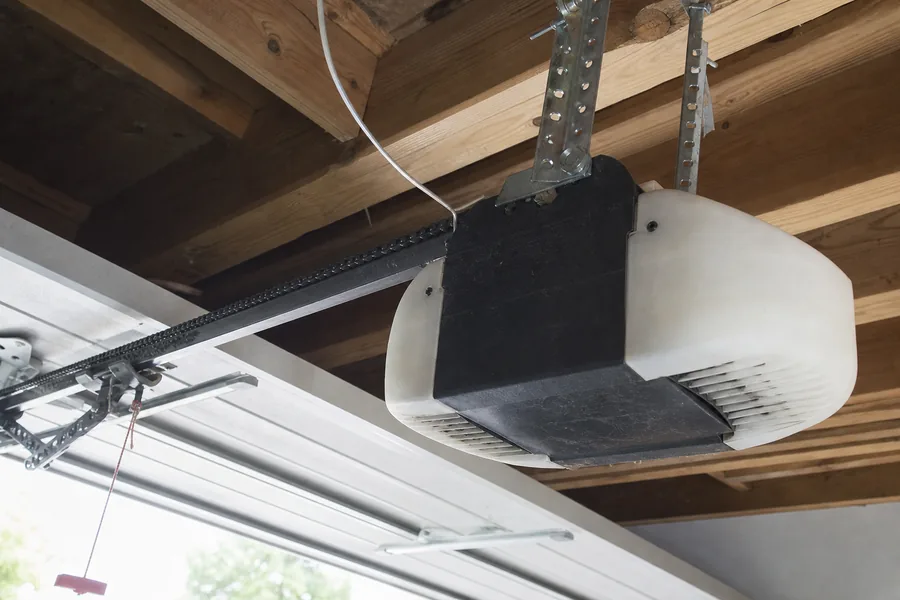
An unbalanced door. If the spring isn't carrying the weight, the opener is, and the nylon gear inside it's the part designed to give way first. An opener that strains is an opener with months left.
Dry hardware. Hinges and rollers that have never been lubricated add drag to every cycle, and drag is spent cycle life. It's the difference between a spring reaching its rating and falling well short of it.
Ignored warnings. A frayed cable, a seized roller or a door that has started to sit crooked is a straightforward repair for a few weeks and a much larger one afterwards.
And forcing it. Every attempt to run a door that has already failed moves load onto parts that weren't designed to carry it.
Less than the industry likes to imply. Torsion hardware is torsion hardware, and a spring, a cable and a roller are the same components whoever stamped the panel. Where the brand does matter is parts availability and a handful of proprietary designs.
| Brand | Notes |
|---|---|
| Amarr | Sections and hardware are widely available and the tracking is standard, which keeps repair costs sensible. |
| Craftsman | Built on Chamberlain internals for most of their production run, so the gear kits and boards are shared and readily available. |
| Overhead Door / Raynor | Standard torsion hardware on the residential lines. Nothing unusual to source. |
| Sommer / Marantec | Less common here, direct-drive heads, and the parts have to be ordered. So we confirm the model before the van is loaded. |
| Genie | Screw-drive and belt-drive heads. Intellicode remotes and carriage assemblies are the usual failure points, and both are parts rather than a reason to change the opener. |
| Clopay | The most common door brand we work on. Panels, hinges and struts are orderable individually, so one damaged section doesn't mean a whole door. |
If yours isn't there, it's almost certainly still standard torsion hardware. Read us the badge on the door or the model number off the opener when you call and we'll confirm before the van is loaded.

One technician, one van, one job at a time, and the same process whether it's two in the afternoon or two in the morning.
The fault is confirmed on the door rather than guessed at down a phone line. The work is written down before anything is touched. Nothing is added afterwards. If something else is found once the door is apart, it's shown to you and agreed separately.
The door is cycled, balanced and its safety reversal tested before we leave, and the work is warranted in writing. That is the whole of it, across King County.
The radius is drawn around how fast a van can actually get to you, not around how much of the map we would like to claim. In practice that's King County and these neighborhoods and towns.
If you are on the edge of it, say where you are when you call and you will get a straight answer about timing before anything is booked.
A roller that has stopped turning doesn't stay a roller problem. It drags, and what it drags is the track, so a small part left too long becomes a track section and a realignment. If the van is already there for a cable, the rollers cost parts and almost no extra labor.
Usually, yes. We hold same-day slots for Bellevue and the surrounding towns, and a door stuck open or a car shut in goes to the front of the list.
If a spring or cable has failed, no. Leave it down and don't force it. The counterbalance holds a great deal of stored energy and it can let go without warning.
Yes - LiftMaster, Chamberlain, Genie, Craftsman, Clopay, Amarr, Wayne Dalton and the rest. The mechanisms are common across brands and we carry parts for all of them.
Yes. Card, and everything is documented in writing. Nothing is cash-only and nothing is agreed on the doorstep without it in writing.
Yes, in writing, on parts and labor. If the same fault returns inside the warranty period we come back and put it right at no charge.
One call gets you a two-hour arrival window rather than a day, and a technician who rings before setting off. No lead auction, no bidding, no stranger quoting your door by phone.
Free visit, free written estimate, fixed price agreed before anything is touched. Throughout Bellevue and Kirkland, Redmond, Renton, Issaquah.