Before you buy a new one: an opener that strains is usually reporting a spring problem, not an opener problem. Replacing the head won't fix that.
Tell us what the door is doing. No charge to come out, and nothing to pay if you decide against it.
Most garage door opener repair calls we take in Bellevue start the same way. The door moved fine yesterday. That is normal. The components that fail are load-bearing, and load-bearing parts fail suddenly rather than gradually. In Bellevue, persistent moisture warps wood and pits hardware, which is why we carry the parts for it on the van rather than ordering them in.
An opener doesn't lift anything. It positions a door that the spring has already made weightless, and holds it where it's put. The motor turns a worm which drives a nylon gear, and that gear is soft on purpose. Engineered to be the first thing to fail, because a stripped gear is an afternoon and a burned-out motor or a bracket torn off a door is not.
Bellevue, Kirkland, Redmond, Renton, Issaquah and the rest of King County are all inside the normal radius. The visit costs nothing, the written estimate costs nothing, and the price is fixed before a tool comes out.
The tell is a mismatch between sound and movement. Press the button, the motor runs at completely normal pitch for its usual few seconds, and the door doesn't twitch. That is the gear, stripped, and a gear kit is a small fraction of a new opener. Look up at the rail: the trolley isn't moving either.
If any of that matches, a technician can diagnose it on site in about ten minutes. We don't guess at it down the phone, and we don't charge to look.
Photo eyes are the part worth caring about. Every unit sold in the United States since 1993 has them, and if the door doesn't stop and reverse when that beam is interrupted, the safety system isn't working. That's a different category of problem from an inconvenience. Test it monthly with something solid laid flat, and we test it on every visit whether or not it's why we were called.
Doing nothing is genuinely the right move here, which isn't advice people are used to getting. A door that has already failed doesn't deteriorate sitting still; it deteriorates every time somebody presses the button to see whether it's still broken.
The one exception is getting a car out. Release the opener with the door fully closed, lift with your legs, and stop immediately if it feels heavy. Heavy means the counterbalance isn't working and the door will come back down on its own.
People put this off, and it is worth being straight about where that goes. None of the following is unusual. It's the ordinary sequence, and we see it in Bellevue every week.
The visit and the written estimate are free, so finding out where you stand costs you nothing at all. That is the whole reason to call early rather than late.
Garage door failures aren't spread evenly through the year, and in Bellevue they cluster predictably enough to plan around.
Cold months take the springs. Steel loses a little ductility as the temperature drops, so a spring already near the end of its cycle life fails on a cold morning rather than a mild afternoon.
Warm and stormy months take everything else. Seals crack, lubricant thins and runs off the coils, and wind-driven grit works into roller bearings and track. In Bellevue that matters more than the national averages allow for, because persistent moisture warps wood and pits hardware.
The useful conclusion is about timing rather than parts: service the door before the season that breaks it, not after.
Every job runs the same way, and it's worth knowing what that's before you pick up the phone.
You'll get a real arrival window rather than a day, and a call before the technician sets off. If we're going to be late you hear it from us first.
Nothing is charged for the visit or for the estimate. The technician looks at the door, tells you what has failed and why, and writes the price down. If you decide against it at that point you owe nothing and there's no pressure applied.
If you go ahead, what was written down is what happens. The only way that changes is if something else is found once the door is apart, and then it's quoted separately and agreed before it's done. Not added on at the end.
Before we leave, the door is cycled several times, balanced by hand, and the opener's safety reversal is tested with an obstruction. The work is warranted in writing on parts and labor.
Frequency and rolling-code generation both matter. A modern Security+ 2.0 remote will not pair with a 1990s 315MHz head, and vice versa. Read us the model number off the back of the motor unit and we'll bring the right one.
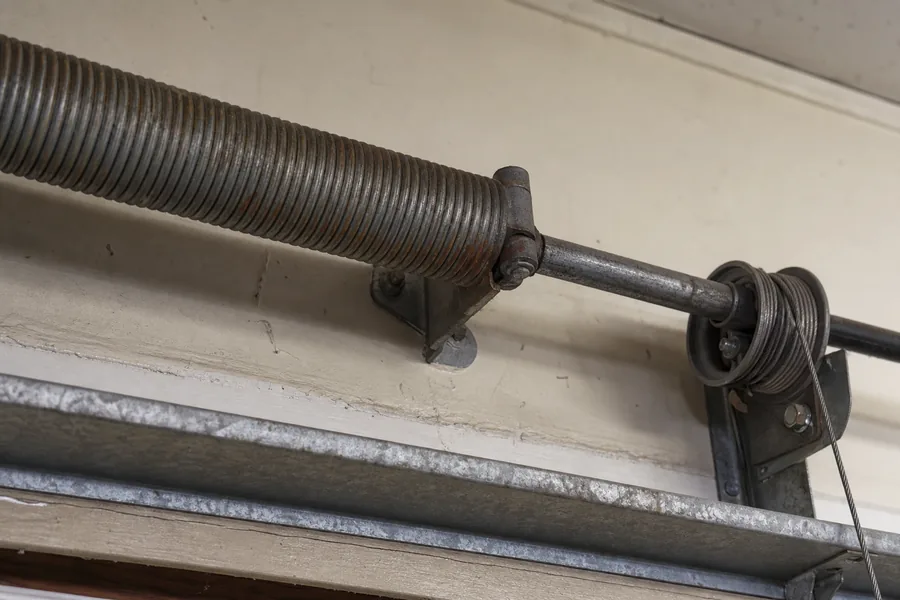
It doesn't, and this misunderstanding costs people openers. The spring carries the weight; the opener only moves a weightless door along its travel. An opener that's straining is telling you the spring is wrong, and replacing the opener won't fix it.
Four faults cover most opener call-outs: photo eyes out of line, a stripped drive gear, a drifted limit switch, and a failed board. Three of those are a part and an hour. We tell you which one it's before you spend anything.
None of that is unique to Bellevue. It is simply what happens when a door is quoted over the phone by somebody who hasn't seen it, and it's the reason we don't give prices before a technician has stood in front of the door.
The difference between a job finished today and a job finished on Thursday is almost always whether the right part was on the van when it arrived. So the van is loaded for what Bellevue actually breaks rather than for a national average.
Springs in the common sizes, lift cables, drums, rollers, hinges, brackets, opener gear kits, remotes, safety sensors and weather seal all travel with the technician. Panels and complete doors are ordered, and we tell you that at the estimate rather than on the day.
It's also why the description you give on the phone matters. Tell us what the door is doing, what it sounds like, whether it's a single or a double and roughly how old it's, and the van leaves already carrying the answer.
Most of what shortens a door's life in Bellevue is preventable, and none of it takes long.
Twice a year, put a lithium or silicone garage door lubricant on the hinges, the roller stems and the spring coils. Not WD-40, which is a solvent and strips what's already there, and not grease on the track, which collects grit and makes it worse.
Once a year, test the balance. Close the door, pull the release cord, and lift it by hand to waist height. A correctly balanced door stays where you put it. If it drops or climbs, the spring is out and the opener is carrying weight it shouldn't be.
Every few months, test the safety reversal. Lay something solid flat under the door and close it. It should touch, stop and go back up.
Less than the industry likes to imply. Torsion hardware is torsion hardware, and a spring, a cable and a roller are the same components whoever stamped the panel. Where the brand does matter is parts availability and a handful of proprietary designs.
| Brand | Notes |
|---|---|
| Craftsman | Built on Chamberlain internals for most of their production run, so the gear kits and boards are shared and readily available. |
| Genie | Screw-drive and belt-drive heads. Intellicode remotes and carriage assemblies are the usual failure points, and both are parts rather than a reason to change the opener. |
| Amarr | Sections and hardware are widely available and the tracking is standard, which keeps repair costs sensible. |
| Sommer / Marantec | Less common here, direct-drive heads, and the parts have to be ordered. So we confirm the model before the van is loaded. |
| LiftMaster / Chamberlain | The same units under two names. Gear kits, logic boards and Security+ 2.0 remotes are stocked, and the older 315MHz heads can still be paired. |
| Wayne Dalton | The TorqueMaster counterbalance is a spring inside the tube rather than on it, and it needs its own tools and its own parts. We carry them. |
If yours isn't there, it's almost certainly still standard torsion hardware. Read us the badge on the door or the model number off the opener when you call and we'll confirm before the van is loaded.

One technician, one van, one job at a time, and the same process whether it's two in the afternoon or two in the morning.
The fault is confirmed on the door rather than guessed at down a phone line. The work is written down before anything is touched. Nothing is added afterwards. If something else is found once the door is apart, it's shown to you and agreed separately.
The door is cycled, balanced and its safety reversal tested before we leave, and the work is warranted in writing. That is the whole of it, across King County.
Bellevue is the base and the surrounding towns are within the normal working radius. These are the areas the van is in most days:
Emergency and after-hours calls run to the same map. A door standing open overnight anywhere on that list gets somebody out.
Yes - LiftMaster, Chamberlain, Genie, Craftsman, Clopay, Amarr, Wayne Dalton and the rest. The mechanisms are common across brands and we carry parts for all of them.
Twelve to fifteen years is a fair run for a chain drive, and a belt drive is similar but far quieter about it. What shortens that's rarely age. An opener that has spent a year hauling on a spring that had gone soft has been doing several times its design work every single cycle, and the part that pays for that's a nylon gear.
Yes, in writing, on parts and labor. If the same fault returns inside the warranty period we come back and put it right at no charge.
Yes - Kirkland, Redmond, Renton, Issaquah and the wider King County area are all inside our normal service radius.
If a spring or cable has failed, no. Leave it down and don't force it. The counterbalance holds a great deal of stored energy and it can let go without warning.
Yes. Card, and everything is documented in writing. Nothing is cash-only and nothing is agreed on the doorstep without it in writing.
If the door in your Bellevue garage is doing any of the things on this page, the fastest route to an answer is a phone call. Describe what it's doing and you'll get a straight opinion on whether it needs somebody today or whether it can wait.
No call center, no booking charge, and nothing at all for the visit or the estimate. We cover Bellevue and Kirkland, Redmond, Renton, Issaquah.
Tell us what the door is doing and we'll give you a real arrival window. The visit and the written estimate cost nothing, anywhere in King County.
Prefer to talk it through? Call (425) 696-3671.
Tell us what the door is doing. No charge to come out, and nothing to pay if you decide against it.