Parking garages under condo and apartment buildings, service bays, shops and small warehouses all run on doors that cycle far more often than a house door ever will. Swift Garage Door Repair repairs sectional overhead doors, rolling steel doors and roll-up sheet doors on them, and the estimate is free.
Tell us what the door is doing. The estimate is free and you can say no.
The door at the bottom of a condo or apartment ramp opens and closes all day long as residents come and go, deliveries arrive and visitors are buzzed in. Standard springs wear out quickly at that pace. High-cycle springs, heavier cables and commercial rollers are what keep a door like that from becoming a monthly call.
Work on a shared building door is planned with the building manager or the association: when the door can be taken out of service, how residents get in and out meanwhile, and which repairs come first. Everything is written up for the board when it needs a vote.
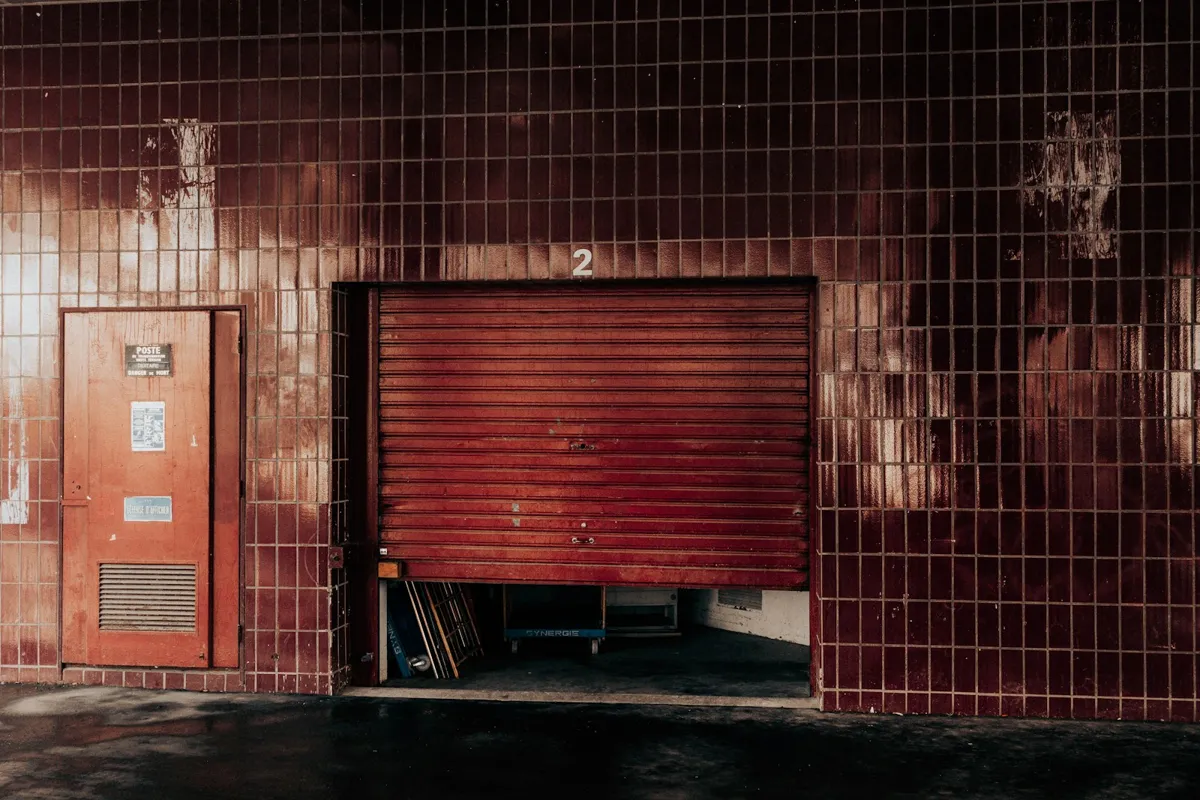
Most commercial openings around here are one of four types. Sectional overhead doors, steel or insulated and sometimes full-view glass on a showroom or a restaurant patio, run on tracks like a house door, only heavier. Rolling steel doors coil around a barrel above the opening, with the springs inside the barrel and the curtain running in steel guides.
Roll-up sheet doors are the lighter corrugated kind found on storage units and small shops. Rolling grilles do the same job as a rolling door but let light and air through, and they protect storefronts and building entrances after hours. Each has its own springs, its own weak points and its own way of failing. If you're not sure which kind you have, describe the door and read out the label on it when you call, and that is usually enough to tell.
Springs are the most common failure, because a commercial door may cycle more in a month than a house door does in a year. Cables fray at the bottom brackets, rollers wear flat and start to grind, and hinges crack along the busiest sections.
Impact damage comes next. A delivery truck backing in too close or a pallet jack clipping the bottom section can bend a panel, kink a track or push a guide out of line, and the door then binds at the same height every day. Damaged sections can usually be replaced on their own, and a bent track is straightened or swapped before it pulls the door out of its rollers.
The rain does its part too. Bottom seals split, and water pooling at the sill corrodes the lowest section of the curtain first.
Commercial operators come in a few designs. Trolley operators pull the door along a rail, the way a house opener does, only built heavier. Jackshaft operators sit beside the door and turn the spring shaft directly. Hoist operators carry a chain release so a rolling door can be raised by hand when the power is out.
Most commercial doors close from a three-button station or a timer, and they rely on a reversing edge along the bottom bar and photo eyes across the opening to stop for a person or a car. A damaged edge or a misaligned eye is a safety repair, and it goes ahead of anything cosmetic on the estimate.
A shop that cannot close its door at the end of the day, or a garage gate stuck open under a building full of cars, is the call that comes first. The first job on site is getting the opening secured, closed and locked, even when a part has to be ordered for the full repair.
Once the building is safe, the rest is scheduled around your hours, so a bay is not taken out of service in the middle of the busiest part of the day.
A loading or service door that no longer seals lets rain blow in across the floor and lets warm air out of a shop that runs heaters through the winter. New bottom seals, side and top weatherstrip and, on a rolling door, fresh seals in the guides are among the simplest repairs on the list, and the difference shows by the next storm.
Where a business heats its bays, an insulated sectional door is worth weighing against the old single-skin one. That comparison goes on the estimate as an option, never as a requirement.
Business doors get the same order every time, so nothing is guessed at.
Plenty of smaller rolling doors and storage doors still go up by hand or by chain. If the door is sound and the springs are matched to it, it can usually be motorized, so a button or a keyed switch replaces the chain. The springs are checked at the same time, because a motor should never be lifting a door the springs have given up on.
Older operators that keep losing boards or limit settings are written up with two options: the repair, and a new operator sized to the door, each with the reason beside it.
Yes. Rolling steel doors, roll-up sheet doors, rolling grilles and sectional overhead doors are all part of the work.
Yes. Shared building doors are planned with the building manager or association, including how residents get in and out while the door is out of service.
Work can be scheduled around your hours whenever the door allows it. A door that will not lock is handled first, and the rest is planned around you.
Usually not. Damaged sections or slats can often be replaced on their own, and a bent track or guide straightened or swapped.
In most cases, yes, if the door is sound and the springs are matched to it. The springs are checked first, and the operator is sized to the door.
Yes. Roll-up sheet doors on storage units and small shops are repaired too: springs, dented or torn sheets, latches and the guides they run in.
Yes. List every door that needs attention when you call, and each one gets its own lines on the estimate.
Yes. The doors are inspected, the estimate is written door by door, and nothing starts until you approve it.
Just a name, a number, and a line about the door. Everything before you agree to it asks nothing of you, across the whole of King County.
Want to talk instead? Call (425) 696-3671.
Tell us what the door is doing. The estimate is free and you can say no.