A heavy door that gets looked after rarely surprises anyone. Swift Garage Door Repair runs tune-up visits across Bellevue and its neighbors: the door balanced and inspected part by part, the opener set to it, and the safety devices proven. Anything worn is written up first, with a free estimate.
Tell us what the door is doing. The estimate is free and you can say no.
A tune-up is a full look at the door and the opener, done in a set order so nothing gets skipped. It starts with the balance: with the opener disconnected, the technician raises the door by hand and lets go at a few heights to see whether the springs are holding the weight or leaving the opener to do it.
Then come the parts that wear. The springs are inspected along their length for pitting, stretched coils or a gap forming. Both cables are followed from the drum to the bottom bracket, where fraying usually starts. Rollers, hinges and the track brackets are checked for wobble, wear and loose fasteners, and the tracks for alignment with the door.
The opener gets its own pass: force and travel limits set to the door as it runs today, the photo eyes aligned, and the auto-reverse proven against an object on the floor. The technician lubricates the moving metal parts that need it with a product suited to them, and the bottom seal is checked for cracks and gaps.
Wood overlays, thick insulated steel and full-view glass all weigh more than the basic doors builders hang, and the springs on them work much closer to their limit. A small loss of tension that a light door would hide shows up on a heavy one as a door that drifts down, lifts unevenly or makes the opener labor.
Cables carry that weight too. A cable that has started to fray under a heavy door gives far less warning than one on a light door, which is why a heavy door is worth seeing before something parts rather than after.
The same goes for the opener. One that has been dragging an out-of-balance door for a year wears its gears and board early, and the tune-up is usually where that strain is first caught.
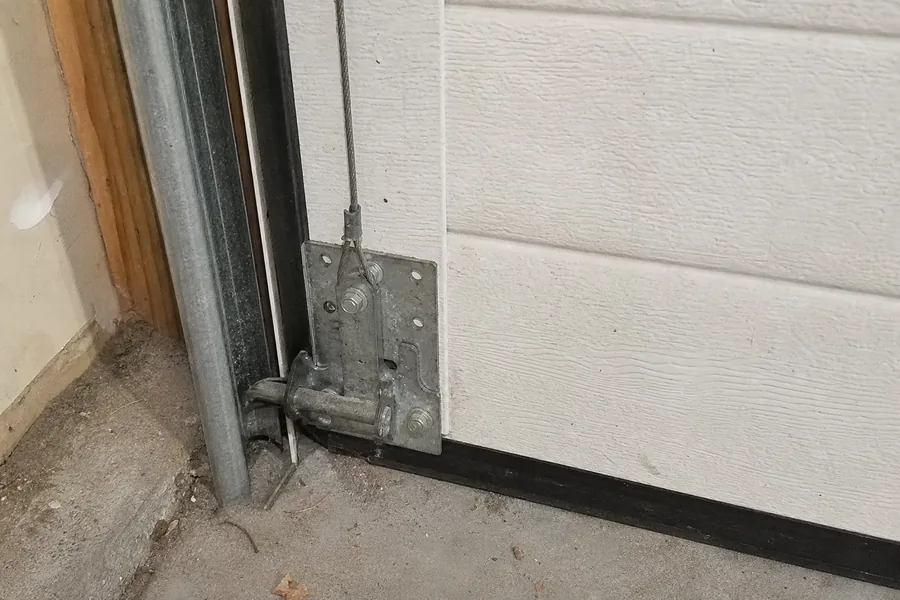
Winters here are mild but rarely dry, and a closed garage holds that damp air for weeks. Over time it pits spring coils, rusts the open bearings in basic rollers and works into cables where they loop through the bottom brackets. Little of it shows from the driveway.
A visit before the rainy season settles in is a good habit for that reason. Parts that are starting to rust are noted, and where rollers or cables are close to done, the choice of sealed-bearing rollers and galvanized cables is offered, since they hold up far better in this climate.
Weather seals are part of the same story. A bottom seal that has stiffened and split lets rain run under the door, and the panel and track behind it pay for it.
Doors usually announce what they need. A grinding or rasping sound along the sides points to rollers. A pop or a bang as the door starts to move is often a spring or a cable riding up on a worn drum. Jerky travel, a door that slows near the top, one side reaching the floor before the other, or a door that reverses for no clear reason all say something has drifted out of adjustment.
A door that feels heavier than it used to when the power is out is one of the clearest signs of all, because it means the springs are carrying less of the weight. Any of these is worth a call before it turns into a door that will not open on a weekday morning.
Light showing under the closed door, or a puddle that forms inside after heavy rain, belongs on the same list. Both mean the bottom seal has stopped doing its job, and a door that lets water in wears faster from the bottom up.
A full-view door is rigid. An aluminum frame holding glass or polycarbonate cannot twist the way a steel or wood door can, so an uneven lift puts the strain straight into the frame joints and the panes. A roller that drags makes the door jerk, and a jerk is what cracks glass.
On these doors the tune-up pays particular attention to even cable tension, roller condition and the frame corners, and every pane is looked at for chips that tend to spread.
Same order on every door, whatever its size.
In townhome communities the association often coordinates door work, and a tune-up can be scheduled for a row of doors at once so neighbors are not booking separately.
Shared garages under condominium buildings are a different case: one large door on a commercial operator, running many times a day. Those doors wear on a commercial schedule and are worth seeing more often than a house door. The visit is planned with the building manager and follows the building's access rules.
A balance test with the opener disconnected, an inspection of the springs, cables, rollers, hinges and tracks, opener force and travel settings, photo-eye alignment, an auto-reverse test, a look at the seals, and lubrication of the moving metal parts by the technician.
It depends on how heavy the door is and how often it runs. A heavy or busy door benefits from more frequent visits than a light one that opens twice a day. After the first visit you hear what your door actually needs.
No visit makes a spring last forever. What it does is catch the signs, a gap forming or pitting in the coil, while the door still works, so the spring is replaced on your schedule instead of on a bad morning.
Often a tune-up is enough. If the noise turns out to be a worn roller, a fraying cable or a tired spring, you hear exactly which part and why, with a free estimate, before anything is replaced.
Yes. Both get the same inspection, with extra attention to even lift on glass doors and to the overlay boards and the bottom edge on wood ones.
Only with your agreement. Worn parts are listed first, with the reason, and nothing is swapped unless you say yes.
Yes. The door is looked at, anything worn is written up, and the estimate is free before any work goes beyond the tune-up you booked.
Just a name, a number, and a line about the door. Everything before you agree to it asks nothing of you, across the whole of King County.
Want to talk instead? Call (425) 696-3671.
Tell us what the door is doing. The estimate is free and you can say no.