
A dented bottom section or a cracked panel does not always mean a whole new door. Swift Garage Door Repair swaps single sections around Bellevue and the towns east of the lake when the original design is still made, and says so plainly when it is not. The estimate is free.
Tell us what the door is doing. The estimate is free and you can say no.
Most damaged doors we see are sound everywhere except one row. A bumper that kept rolling after the brakes went on, a basketball that found the same spot all summer, a bike handlebar caught on the way in: the damage lands on one section and the rest of the door is fine.
A shallow dent in the middle of a panel is mostly cosmetic. The ones that matter sit on a hinge line or bend the edge where two sections meet, because the door then folds badly as it rolls into the curve of the track. That shows up as a hitch partway up, a roller pushed sideways, or a door that closes with a gap at one end.
Cracks deserve the same attention. A split along a hinge line spreads every time the door bends through the curve, and on a heavy door it can let the hinge pull loose.
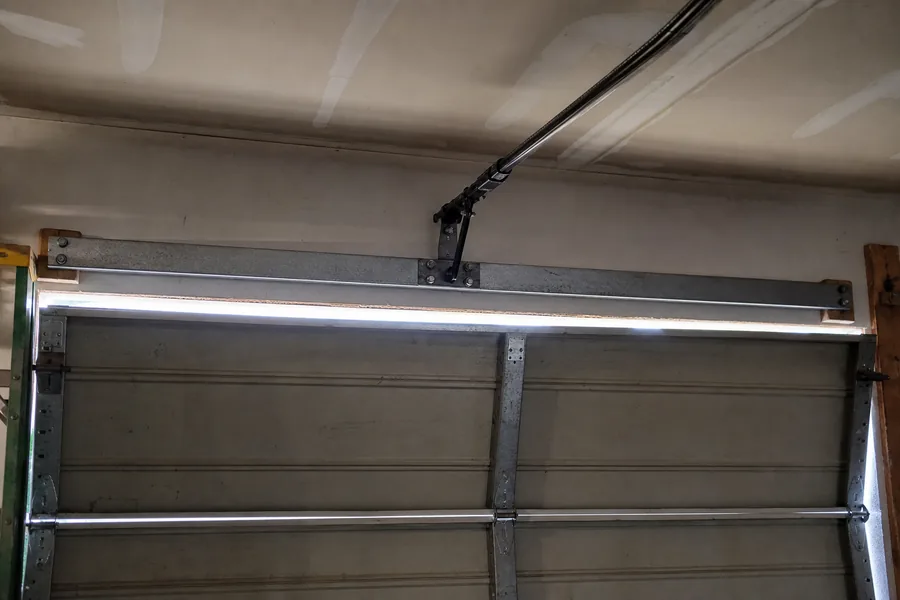
Everything hinges on one question: does the maker still build that exact section? Width, height, thickness, panel pattern, insulation and surface texture all have to match, or the new piece will not seat against its neighbors and the door will look patched.
The answer usually sits on a label on the inside of the door, often on an end stile or the top section, with the maker's name and the design details. From that, the section is looked up before anything is promised. If it is still in production, one section can go in and the rest of the door stays.
Color is the other half. A new section arrives in the factory finish, and a door that has faced years of weather will have shifted a shade. On a light door the difference is often hard to spot; on a dark one it can show. You see the sample against your door before ordering, and painting the whole door afterward is an option if the match bothers you.
The lowest section sits a few inches above wet concrete for months at a time. On steel doors that is where rust starts, usually along the bottom edge behind the seal. On wood overlay doors it is where the boards swell, open at the joints and begin to soften.
A failed bottom seal makes it worse, because rain then runs in under the door and stays against the panel. When the bottom section is swapped, a new seal goes on with it, so the fresh panel is not sitting in the same water that ruined the old one.
If the damage reaches the jambs or the slab has settled toward the door, that is pointed out too, since a new section will not last on a door that keeps sitting in a puddle.
Wood overlay doors are built in layers, with cedar or another species fixed over a steel or composite base. Damage is often confined to the overlay boards, which can sometimes be rebuilt without touching the section underneath. Where the base itself is bent, the section is ordered complete.
Full-view glass doors work differently. A cracked pane or a bent rail is usually repaired on its own; the aluminum section only comes out when the frame itself is twisted.
Insulated steel sections have to match the thickness of the ones beside them. A thinner section in an insulated door sits out of line, lets air through at the joints, and looks wrong from the driveway.
Springs are wound for the weight of the door as it stood the day they went on. A replacement section rarely weighs exactly what the damaged one did, especially when an old wood overlay or a waterlogged bottom panel comes out, so the balance shifts the moment the new piece is hung.
After the swap, the door is lifted by hand and released at a few heights to feel where it wants to go. Spring tension is reset until it stays put, the cables are checked for even lift on both sides, and the opener's force and travel are set to the door as it now runs.
Skipping that step is how a neat panel repair turns into a strained opener a few months later.
Most swaps take two visits: one to measure and identify, one to install once the section arrives.
Sometimes a section swap is the wrong answer. Two or three damaged rows, a design the maker no longer builds, overlay boards rotted through on several sections, or a door that is already near the end of its springs and rollers all point toward a new door.
When that is the case, both options are written up side by side, with the reasons, and the choice stays with you. A new door here usually means rethinking springs and the opener as well, which is covered on our installation page.
Often, yes. If the maker still builds that section in the same size, thickness and pattern, the bottom row can be swapped on its own and a new seal put on with it.
The shape and pattern will. The color depends on how much the old finish has shifted over the years. You see a sample against the door before ordering, and repainting the whole door is an option if you want an exact match.
Then a matching section cannot be ordered, and you hear that before anything else. Small damage can sometimes be straightened or reinforced; otherwise a new door is the honest answer.
No. A dent in the middle of a panel is usually cosmetic. Dents or creases on a hinge line, or ones that make the door catch as it rolls up, are the ones worth replacing.
Usually not. A single pane or a bent rail can normally be repaired on its own, and the section only comes out if the aluminum frame is twisted.
Because the new section does not weigh exactly what the old one did, and springs set for the old weight leave the door heavy or light. That strain lands on the opener if it is not corrected.
Yes. The section is identified and the options explained, and the free estimate comes before anything is ordered or any work starts.
Just a name, a number, and a line about the door. Everything before you agree to it asks nothing of you, across the whole of King County.
Want to talk instead? Call (425) 696-3671.
Tell us what the door is doing. The estimate is free and you can say no.